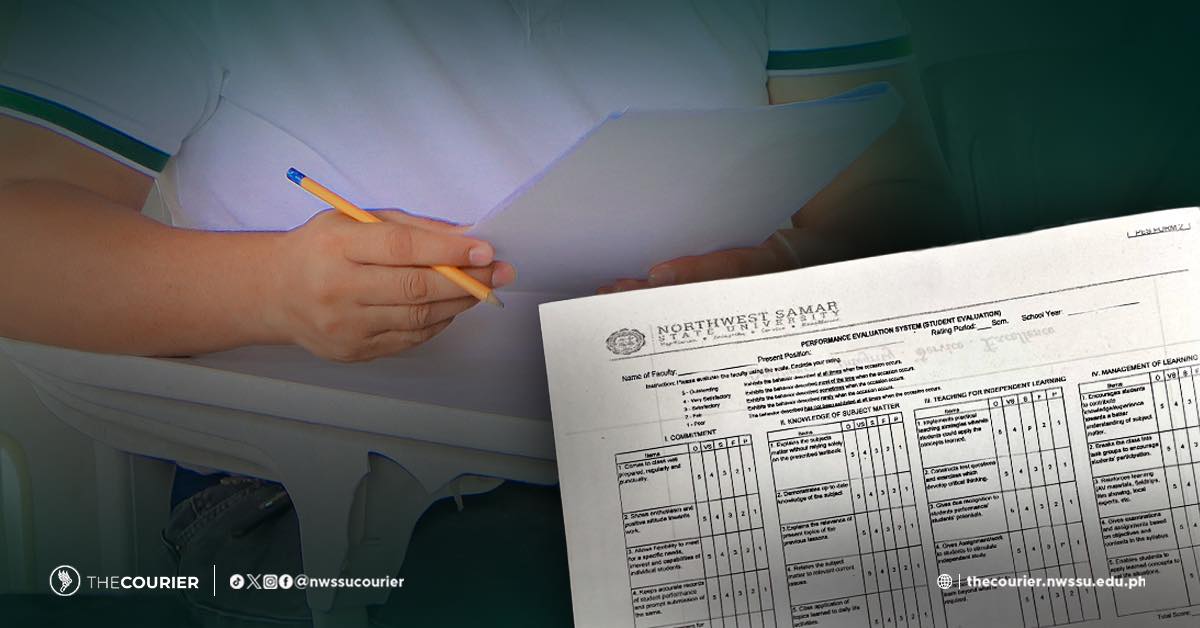
Instructors allegedly trading grades for perfect evaluation
via Vivienne Kyla Caber, Arelyn Ronzon (Former Associate Editor)
with reports from Eunice Marsha Alorro (Former Editor-in-Chief)
“I can give flat one.”
“May plus points sa final grade san nag-evaluate sa akon nga perfect.”
“Send picture san iyo evaluation form with name and pirma niyo.”
These are among the messages anonymously obtained by the publication from Norwesian students, claiming that some instructors required them to give perfect evaluation ratings and submit photos of their completed evaluation forms as proof in group chats during the student evaluation period for teachers.
According to student accounts, the submitted photos allegedly served as a ticket to receiving additional points or even flat one final grades, raising concerns about the integrity of the university’s evaluation system.
TEACHER EVALUATION
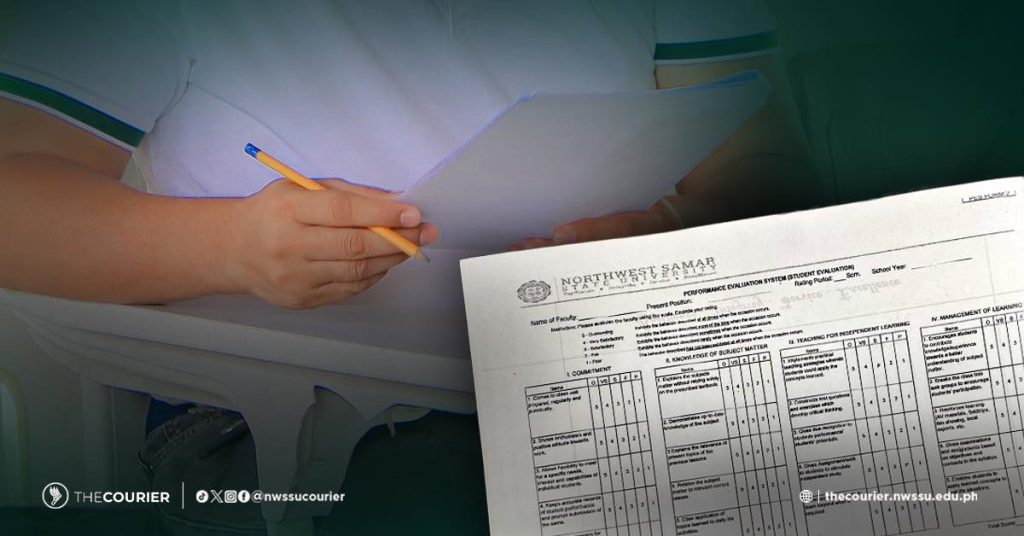
Evaluation for teachers is a mandatory, semester-based process conducted after midterm examinations, where students assess instructors’ teaching effectiveness. Under the Commission on Higher Education (CHED) Memorandum Order No. 19, Series of 2025, students must include their names in structured evaluation forms, which are used for faculty development and incentives, making the system vulnerable if compromised.
According to Dr. Rolyn A. Catamora, Director of the Quality Assurance (QA) Office, “Students need to evaluate teachers to provide feedback on instructional effectiveness, engagement, and overall teaching quality, supporting the academic goal of continuous improvement. The main purpose of teacher evaluations is to ensure high teaching standards, improve educational experiences, and provide actionable insights for professional development.”
Catamora further added that university policy prohibits instructor involvement during evaluations. Faculty members are required to leave the room during evaluations and are not allowed to view completed forms. “We only provide a summary of the results in Excel format,” she said, adding that influencing ratings in exchange for grades is grounds for disciplinary action.
“If proven, the Dean has the authority to determine the consequences,” Catamora said, noting that tainted evaluation scores may be nullified. She urged students to document irregularities in writing and report them through proper channels. “We should practice the correct process for addressing any issues or problems encountered in our school. We are always willing to listen and take the necessary actions,” she added.
Despite being an open secret for years, the issue of manipulated teacher evaluations remains unresolved, raising questions about both the credibility of the system and the ethical standards of educators expected to model integrity.
In an interview with The Courier, Faculty Association President Dr. Leo Lacaba confirmed that such practices are not new, citing a 2014 case in which a former faculty member distributed waiver letters to pressure students into inflating evaluation scores. “This is not acceptable. In fact, it is illegal. It defeats the purpose of a personal evaluation system, which should be done objectively and without interference,” he said.
Lacaba identified monetary incentives as a possible motivation, particularly the Performance Based Bonus (PBB), which requires teachers to earn “very satisfactory” ratings in two evaluation periods. He noted that receiving only “satisfactory” ratings twice can make a faculty member ineligible for the incentive, potentially encouraging unethical practices.
He stressed that educators, as public servants, are bound by the Code of Ethics for Professional Teachers and Republic Act No. 6713, which require public officials to prioritize public interest, professionalism, and integrity. As stated in Section 4(a) of RA 6713, public officials must always uphold public interest over personal gain, while Section 4(b) underscores professionalism by urging government workers to perform their duties with excellence, intelligence, and integrity.
However, Lacaba acknowledged that he has no authority to sanction offenders, emphasizing the need for university intervention.
“Personal evaluation should be done objectively,” he said. “Positive results mean the teacher should continue improving, while negative results should serve as a basis for professional development.”
DUE PROCESS
Student Affairs Services Director Myra L. Pilpa stressed that student evaluations play a crucial role in improving teaching quality. “Even if we receive the worst evaluation, that’s how we will improve. Kasi assessment ‘yan ng mga bata,” she said, describing grade-for-evaluation schemes as dishonest and self-defeating. “Parang niloloko mo lang ang sarili mo… you’re expecting students to give you a rating of 100.”
Pilpa also emphasized that student complaints must follow due process to be properly addressed, urging students to submit concerns in writing through the appropriate offices.
“An formal gud siton you have to write a letter. If not to the dean, to the SAS Office,” she said, adding that reports must be supported by evidence. “We cannot act based on hearsay. There must be a basis.”
She warned that coercing students for favorable evaluations violates the Code of Ethics for Professional Teachers and undermines the purpose of the evaluation system. Teachers, she said, are expected to model integrity. “Ang ginagawa ng matatanda ay ginagaya ng bata. So how could you model your students’ integrity and honesty?”
Assuring students’ safety, Pilpa said the university will act on verified complaints. “Students will be taken care of always. The entire school will not tolerate such behavior,” she said, noting that administrators may separate students from instructors involved in complaints. She also reminded students of their rights under the student handbook and the Safe Spaces Act (RA 11313): “You are protected… and if you ever feel unsafe, you could file a complaint.”
To rebuild student trust in the evaluation system, Pilpa shared that the university plans to include orientation on the importance of student evaluations. She emphasized that students must be informed about the significance and impact of their evaluations.